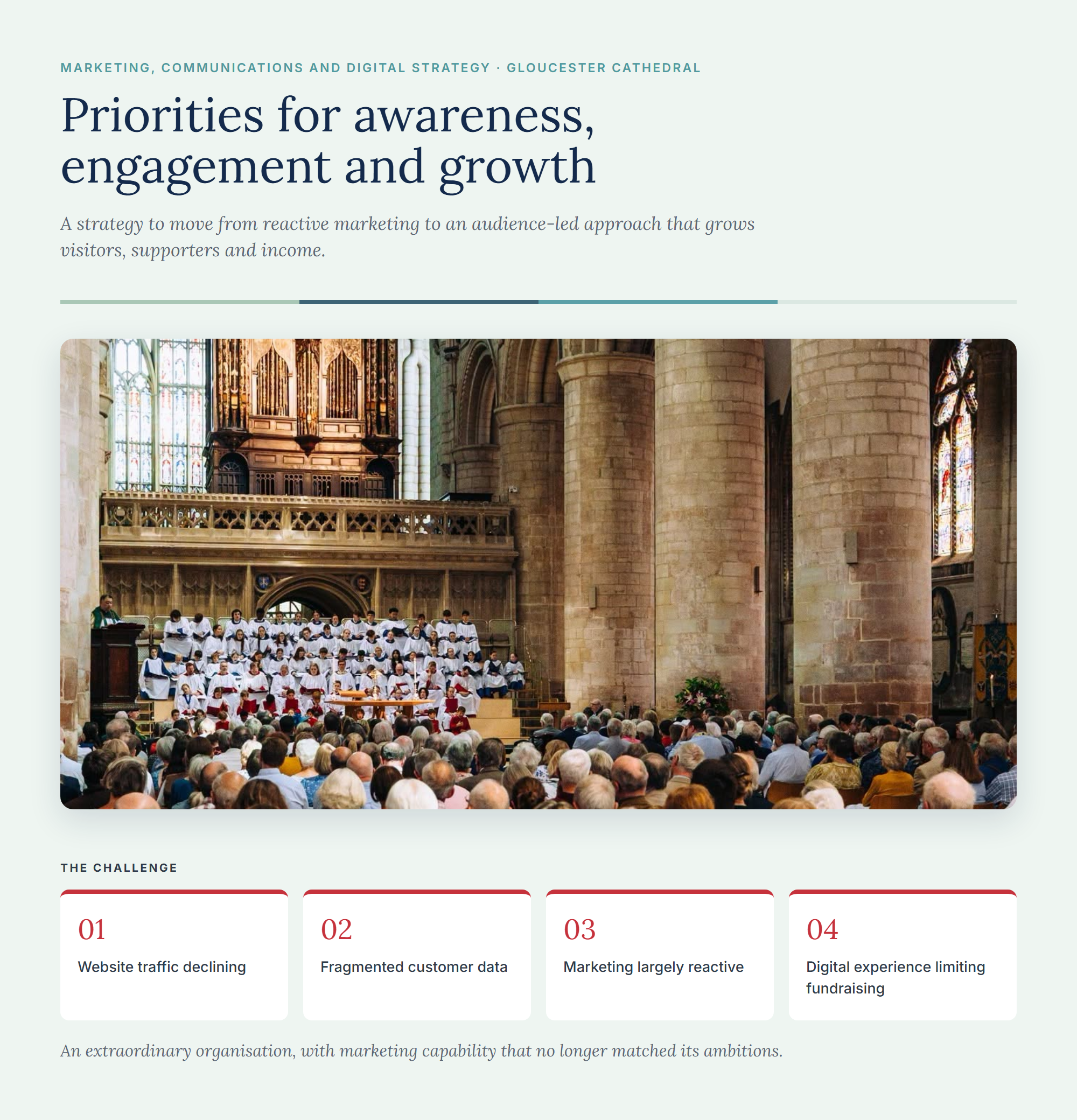

A review of Gloucester Cathedral’s marketing function, leading to a proposed marketing strategy with recommendations on brand positioning, audience development, communications and digital capability.
- ClientGloucester Cathedral
- SectorHeritage and faith
- Work undertakenMarketing strategy, brand proposition and digital recommendations
- Worked withColleagues across the organisation
The context
Gloucester Cathedral is a major heritage, cultural and faith destination, attracting hundreds of thousands of visitors annually. Like many cathedrals, it faces the challenge of balancing its spiritual mission with the need to generate sustainable income, develop audiences and respond to changing visitor expectations.
As such, I was brought in to review the marketing function, consider the Cathedral’s brand positioning and identify opportunities to improve marketing, communications and digital engagement.
What I did
Working with colleagues across the organisation, I developed an extensive marketing strategy that identified strengths, weaknesses, challenges and opportunities to make marketing activity more audience-focused and commercially effective.
The work included:
Insight and research
- Review of visitor feedback and online reviews
- Consideration of audience behaviour and potential market segments
- Identification of opportunities to improve visitor engagement and income generation
Channels, systems and processes
Evaluation and proposals for channels, management systems and processes.
Audience development
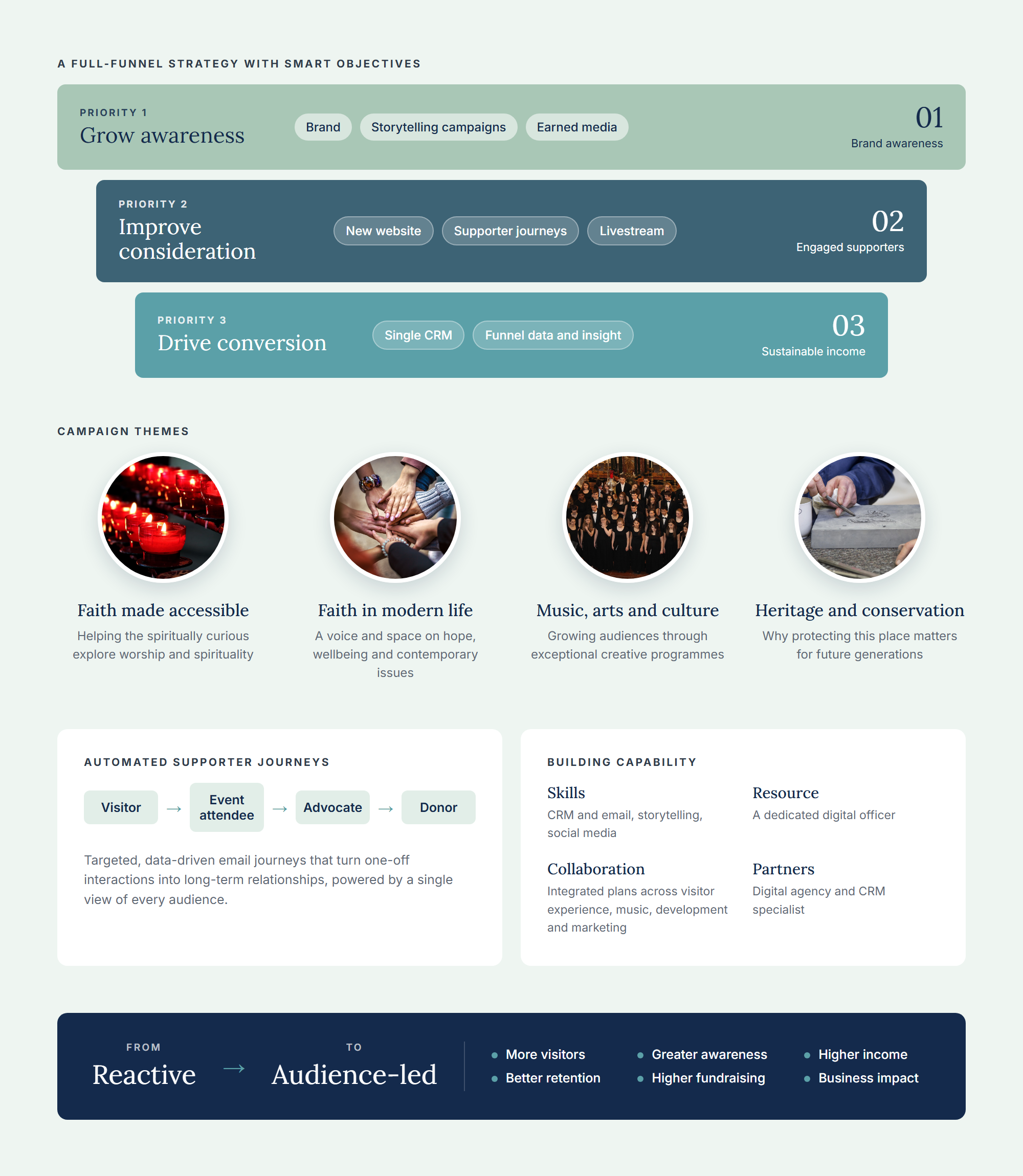
The strategy proposed seven audience segments to inform more targeted marketing and communications activities, including heritage visitors, spiritual seekers, music audiences, families, younger generations, business partners and potential donors.
Brand development
Work was undertaken to explore a clearer brand proposition and messaging framework for Gloucester Cathedral, including the concept of an unexpected wonder for spiritual discovery – an insight that emerged from customer feedback.
Marketing and communications
The strategy proposed a more coordinated, campaign-led approach to marketing and communications, covering powerful stories to reflect faith, heritage, music, events, conservation and fundraising.
Digital development
A number of opportunities were identified to strengthen the Cathedral’s digital presence and infrastructure, including:
- Website development and improved search visibility
- Better integration of audience data and CRM systems
- More effective use of email, social media and the media
- Always-on digital advertising including Google, Meta, LinkedIn and testing AI channels
- Improved campaign measurement and performance reporting
- Greater use of AI, automation and digital management systems
Visitor engagement
The strategy identified opportunities to improve the visitor journey through better interpretation, wayfinding, on-site messaging and clearer opportunities for visitors to engage further with the Cathedral and support its work.
SMART targets
The strategy set out SMART targets across the sales funnel, from brand awareness through to conversion. These were informed by the Cathedral’s historic performance and publicly available competitor insights.
Resources and implementation
The strategy also considered the skills, budgets and staffing needed to deliver the proposed approach.
The outcome
The principal output was a marketing strategy, together with SMART targets and recommendations, including budgets required for success, covering brand positioning, audience development, communications and digital capability. The strategy will help shape how the Cathedral develops its marketing function and audience engagement.
Specific targets have not been included, as they are commercially sensitive.
“Sophie helped us to work more strategically, producing work of the highest quality at incredible speed. She also fitted brilliantly into the team.”
Rebecca Lloyd, Canon Chancellor and Director of Marketing, Gloucester Cathedral