
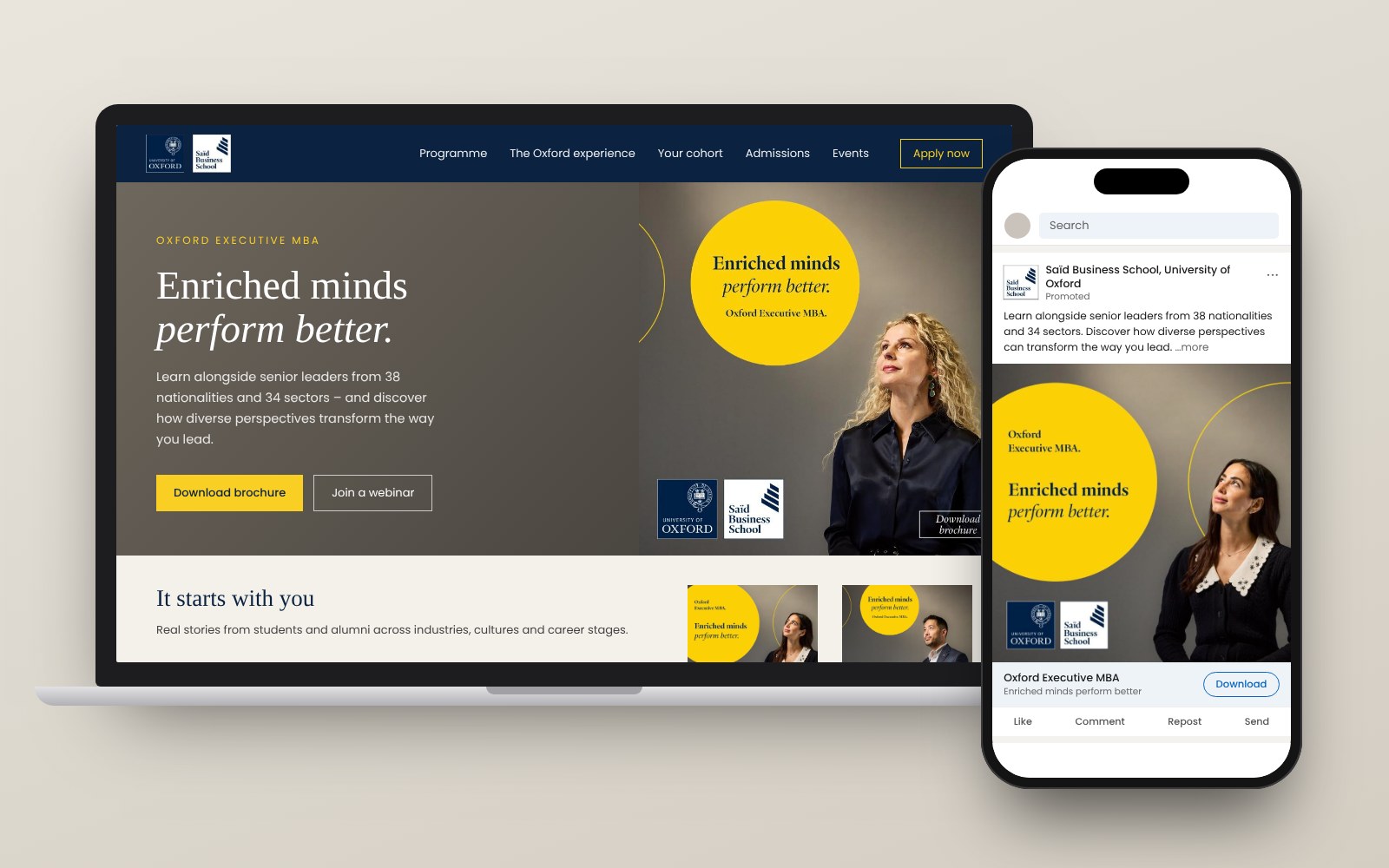
When Saïd Business School asked me to help the Oxford Executive MBA close a gap of around 20 students a year, the answer wasn’t a bigger budget. On the same spend as the year before, the campaign delivered a record intake of 141 against a cap of 140, a 40x return on marketing investment and Silver and Bronze at the HEIST Awards 2026. Here are five lessons from that work that apply to almost any organisation.
1. Listen to the gap between experience and marketing
Students kept saying the same thing: the programme they experienced wasn’t the one the marketing described. Many had initially felt it “wasn’t for someone like me”. That gap was the single most valuable insight we had. If your customers, students or supporters describe you differently from the way you describe yourself, start there.
2. Find the thing competitors can’t claim
Under market pressure, rival programmes had all doubled down on the same messages: networks, flexibility and global modules. The audience saw them as standard. The Oxford programme’s real point of difference was its unusually diverse cohort – but it was missing from the marketing. Your strongest message is often hiding in plain sight, in what people value most about the experience.
3. Emotion triggers the decision; logic justifies it
Executive MBA choices are rationalised through rankings, reputation and career outcomes, but they’re triggered by a desire for change, challenge and personal growth. So we positioned diversity not as surface-level inclusivity, but as intellectual enrichment: Enriched minds perform better. Lead with the feeling, then back it up with the facts.
4. Let real people tell the story
We moved away from Oxford’s iconic architecture and put real students and alumni at the centre, through portraits, blogs, vlogs, webinars and their own LinkedIn networks. Authentic stories consistently outperformed traditional advertising: organic social engagement rose 1,284%, student blog views 582%, and paid social dwell time jumped from 1.7 to 15 seconds.
5. Use data to move money – and to stop things
Analysis of historic application data showed which international regions were most valuable, so we moved budget there and onto proven channels. Live dashboards let us optimise in real time. And when a Meta test brought reach but little intent, we switched it off. Knowing what to stop is as important as knowing what to start.
The results
- 141 students enrolled against a cap of 140, up from 124
- Applications up 41% within eight months
- A 40x return on marketing investment, with cost per student down 12%
- Female participation up from 32% to 35%, with 38 nationalities across 34 sectors
Beyond the numbers, the programme has a distinctive, coherent brand for the first time – and toolkits that other programmes have since adopted. Read the full case study.
Want to find the insight that sets you apart? Get in touch to talk about your brand and campaign strategy.